 Katie
Katie
Scenic Design: The Pillowman
1/4" scale model of a scenic design.
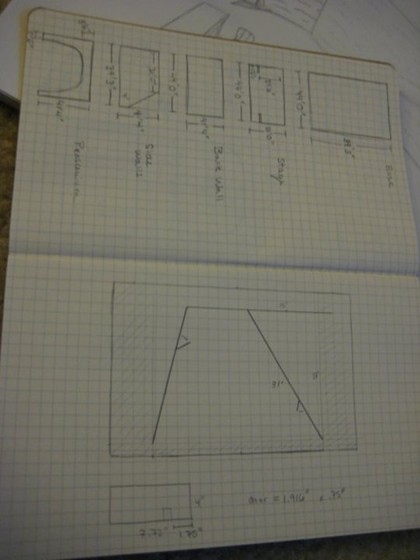
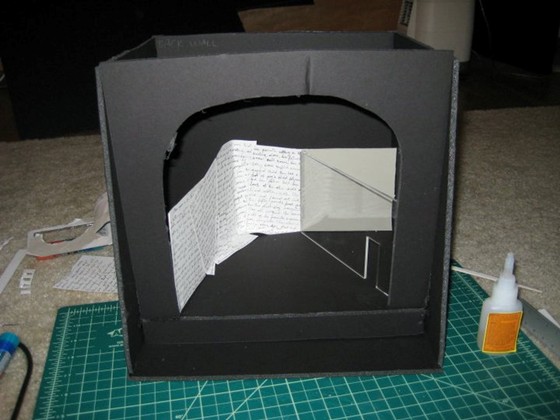
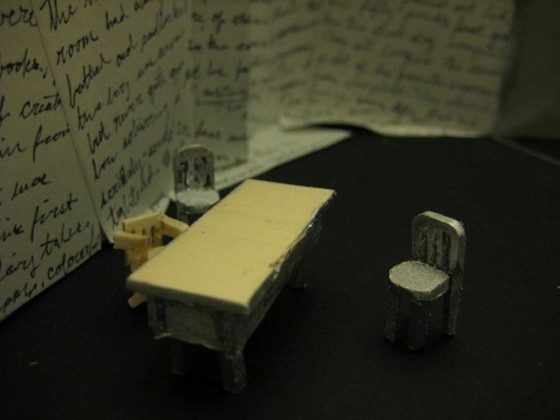
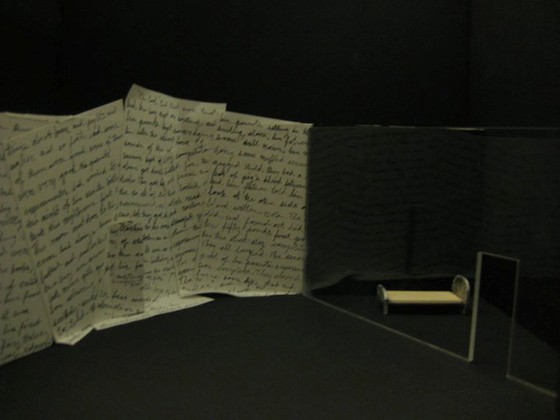
The walls of the set are covered in 8.5 by 11 scaled pages with the text of “The Writer and the Writers Brother”, a short story from the play, handwritten on them. This story is very influential in the structure of the play, as it is semi-autobiographical for one of the characters, and now it forms the structure of the set.
The play is framed by the concept of stories, so the action physically, as well as metaphorically, takes place within the pages of the authors work. The glass wall is intended to be back projected with the same image of handwritten text on paper, forming an opaque wall that acts as a continuance of the other text-covered walls.
The majority of the scenes take place in a police interrogation room in a brutal government-run state. The interior of the interrogation room here is vast and mostly empty, further serving to minimize the characters and create a sense of looming power in the space.
The furniture is Spartan and minimal, consisting of several metal chairs, a wooden office chair and a basic table. The minimal, brutal furniture serves to underscore the dark nature of the play, making the authors (ant the playwrites) words the main focus.
The area behind the glass wall is known as the “story space”. Here the authors stories are acted out in an area separated from reality by a thin, translucent wall. When the projection is turned off, the opaque wall dissolves, revealing a dark world right beside our own, whose tenuous boundary is barely discernible.
Here stories from the authors imagination as well as those from his own childhood are enacted, adjacent to, but not in the same space as the authors own life.
Comments: 0
There are no comments yet, be the first to write a comment!